Histology Feature Extraction#
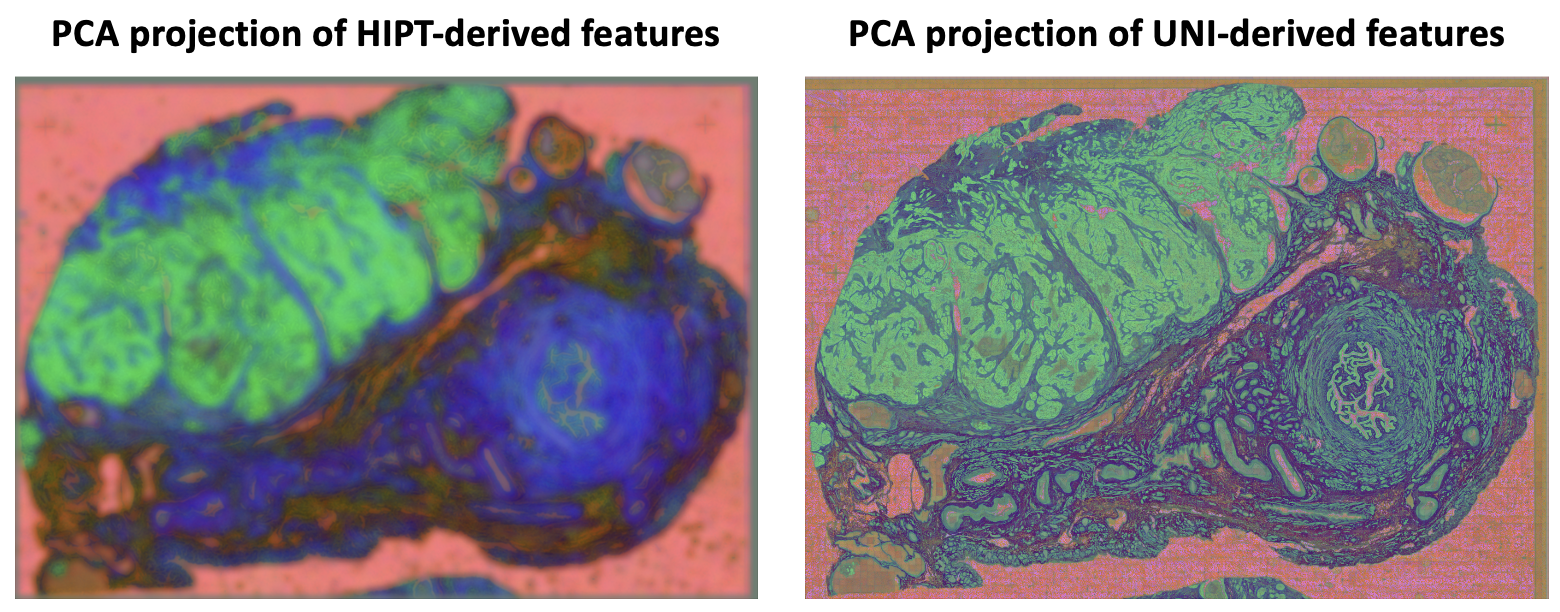
We extract histological features using a dual-model strategy. Specifically, we employed HIPT, a hierarchical vision transformer that captures multi-scale tissue architecture, and UNI, a universal pathology foundation model pretrained across diverse histology cohorts. Leveraging two complementary models allows us to integrate both global contextual representations and fine-grained local morphology.
Global histological feature extraction using HIPT#
First, download model weights of HIPT by running download_pretrained_vit.sh.
python extract_features_vit.py ${prefix} --device='cuda'
Input:
he.jpg, preprocessed H&E image paired with your ST data.- Parameters:
${prefix}: directory to the folder containing the image, i.e.data/.--device: choosing device to use, eithercudeorcpu.
Output:
embeddings-hist-vit.pickle: pickle file containing global and local image features.
The use of GPU is highly recommended.
Fine-grained histological feature extraction using UNI#
First, request access to the UNI model weights from the Huggingface model page at https://huggingface.co/mahmoodlab/UNI.
python extract_features_uni.py ${prefix} --login='LOGIN'
Input:
he.jpg, preprocessed H&E image paired with your ST data.- Parameters:
${prefix}: directory to the folder containing the image, i.e.data/.--login: replace with your own login to access UNI weights.
Output:
embeddings-hist-uni.pickle: pickle file containing fine-grained image features.
The use of GPU is highly recommended.
Integration of global and fine-grained histological features#
Combining two complementary embeddings allows us to integrate global contextual representations (HIPT) with fine-grained local morphology (HIPT & UNI). A unified histology embedding is constrcuted by applying principal component analysis (PCA) to each model’s features (retaining components that explain at least 99% of the variance) and then concatenating the reduced embeddings.
python merge_feature.py ${prefix} --method='pca'
Input:
embeddings-hist-vit.pickleandembeddings-hist-uni.pickle.- Parameters:
${prefix}: directory to the folder containing the files, i.e.data/.--method: method for dimension reduction, options containpca,nmfandica.pcais recommended.
Output:
embeddings-hist-merged.pickle: pickle file containing merged image features.